Vow of Noise: sermon for despair sanctuary
Traditionally, for Christians, despair is a sin. It is regarded as faithlessness. Faith is a conviction of having hope, and despair is a conviction of having no hope. They are diametrically opposed. It is a binary. Faith or despair.
And yet I stand before you today, a minister at a Christian church, and I tell you: if faith and despair are mutually exclusive, then my days of despair outnumber my days of faith.
But I learnt a different understanding of faith from the rabbi Abraham Joshua Heschel. Heschel said, sometimes faith is only loyalty to the faith you’ve had before.
And despair: I learned from Heschel the Bible has prophets of despair.
Like the prophet Jeremiah:
“I looked on the earth,
and lo, it was waste and void;
and to the heavens,
and they had no light. …
I looked, and lo,
the fruitful land was a desert,
and all its cities were laid in ruins. …
For thus says the LORD:
The whole land shall be a desolation.”
The Bible has many expressions of despair. Most famous among them is that of Job. In that story, Job is punished for being righteous. He complains that God has made an unjust world where evil men rule the day, and the rich trample on the poor. God doesn’t so much answer as mock Job:
“Who is this that darkens counsel by words without knowledge?
Gird up your loins like a man,
I will question you,
and you shall answer to me.”
How dare we despair.
We of little faith.
*
“The chief end of man is to glorify God and enjoy him forever.” The first confession of the Westminster Catechism. Children have to memorize it in a lot of churches just like this one.
And you don’t even have to be a Christian to believe it. The stoic philosopher Epictetus said, “If I were a Nightingale, I would perform the work of a Nightingale. If I were a swan, that of a swan. But as it is, I am a rational being, so I must sing the praise of God.”
And even Friedrich Nietzsche, the poster boy for atheism, yet demanded that philosophers declare a grand Yes to all of reality, affirming it as eternally necessary. He believed it will be repeated exactly the same way, over and over, forever, and that we should celebrate that. And like God to Job, Nietzsche mocked those who despair: “the fanatics with bowed heads and drooping hearts who preach: ‘The world is a shitty monster.’”
You may have learned in “Intro to Philosophy” that Nietzsche was opposed to another German philosopher named Hegel, but they share a central premise: Hegel defined philosophy’s goal as “the justification of things as they are.”
So whether you’re Christian, atheist, religious, or rationalist; whether you believe in God, or you think God is dead—everyone seems to agree that we should all be happy with the world we’ve got.
*
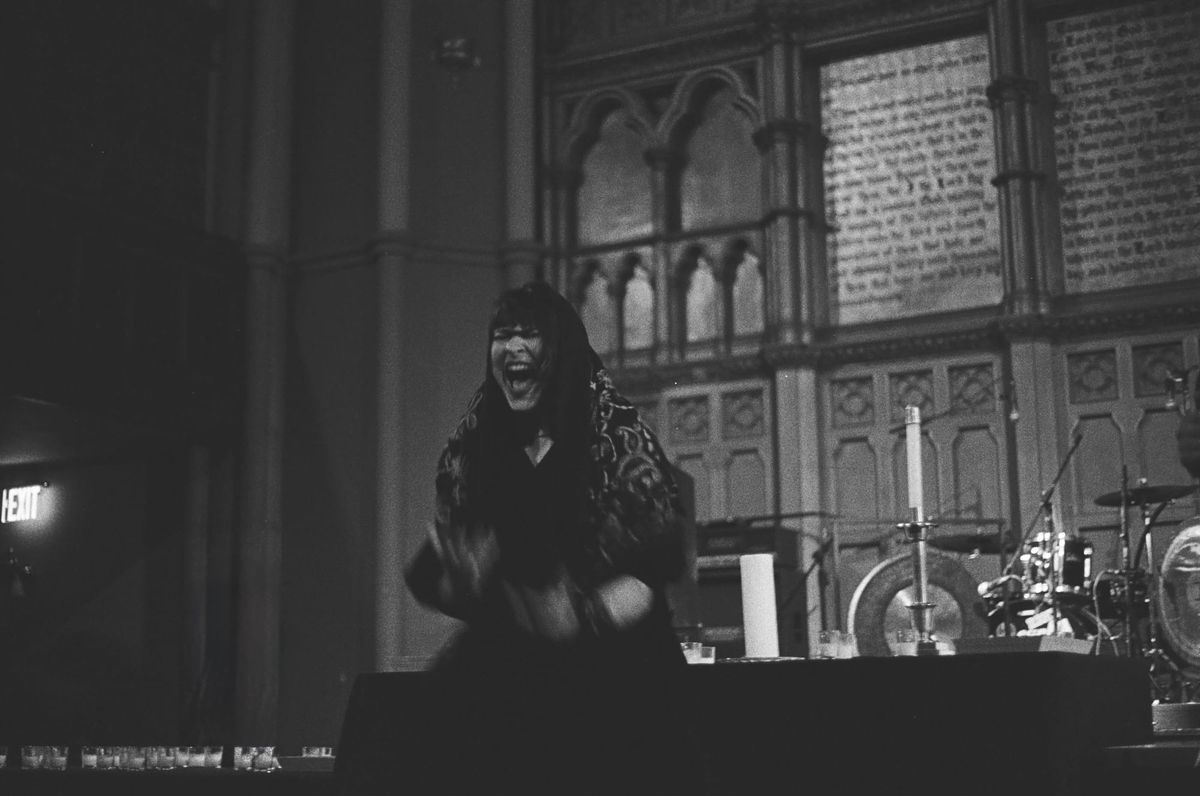
I think it’s quite fitting of us to scream in here.
You know why cathedral ceilings are so high? - So we can hear the sound of our prayers going up to God.
*
In the book of Exodus, when Moses meets God at the burning bush, the first thing God tells him is: “I have heard the cries of my people.”
It is apparently not the bald fact of injustice that stirs the heart of God. It’s the sound of God’s children crying. The human act of crying out in anguish, in this story, is an instigator of divine initiative. God is who hears the cries.
God is who hears the cries.
The cries of families losing loved ones to bombs, to guns, and starvation.
The cries of children in ICE detention centers.
The cries of black and brown people fearing for their lives.
The cries of those desperate to be free of addiction, self-hatred, and depression.
The cries of the jobless, the homeless, and the lonely.
The cries of the very earth itself.
We cry when we are unheard,
and we cry
when perhaps we will be heard.
Despair is not a sin.
Despair is a siren.